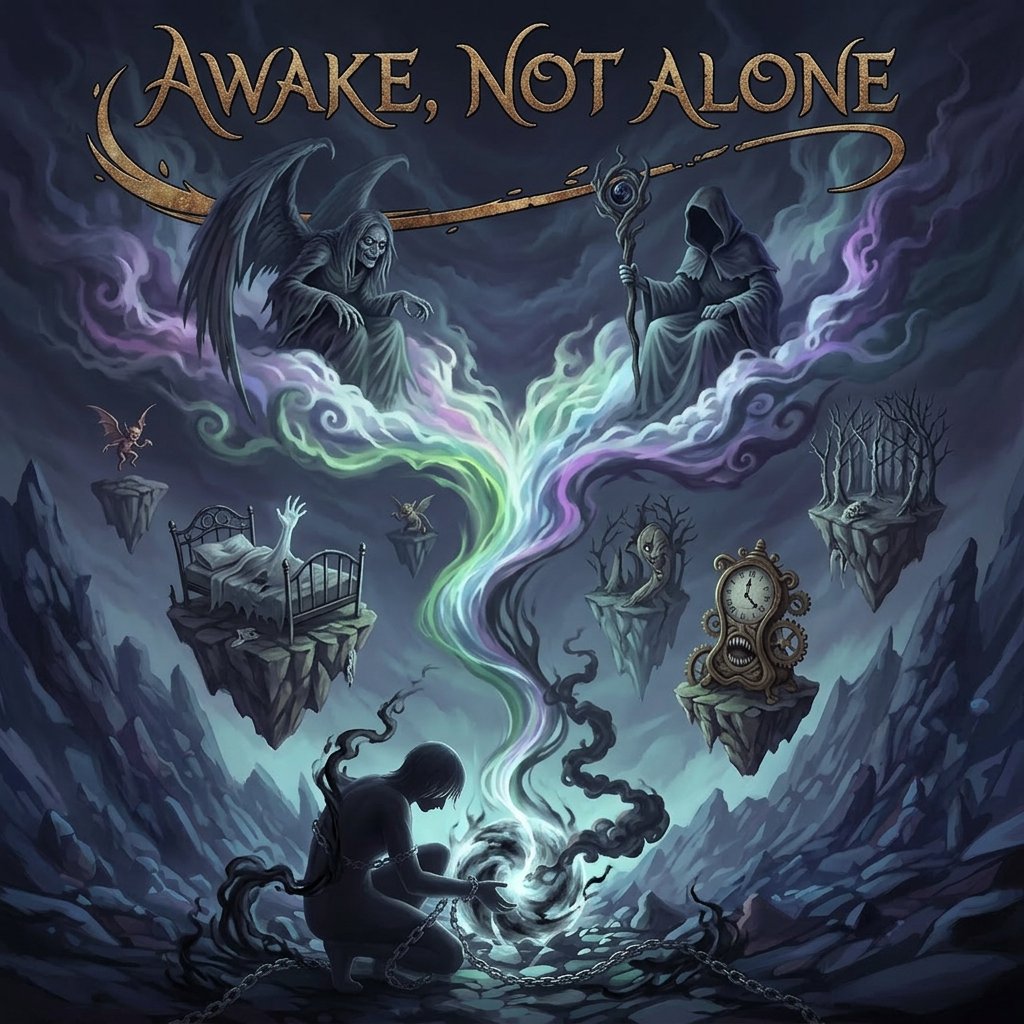
You woke up and couldn't move. Couldn't scream. Something was in the room — you felt it before you saw it — a presence at the foot of your bed, or a crushing weight on your chest, or a shadow standing just at the edge of your vision. And no matter how hard you fought to sit up, to call out, to do anything at all, your body simply would not respond.
If that just happened to you, take a breath. You are not going mad. You are not being haunted. What you just experienced has a name, a mechanism, and — more importantly — solutions. I know because I lived through it more times than I can count before I figured out how to make it stop.
This is everything I wish someone had told me.
What Actually Just Happened to You
Sleep paralysis occurs at the boundary between REM sleep and waking. During REM — the deep dream stage — your brain does something remarkable: it cuts the signal to your voluntary muscles. This is called atonia, and it exists for a good reason. Without it, you would physically act out every dream you ever had. Your body locks itself down to protect you.
The problem is timing. Sometimes — due to stress, sleep disruption, or an irregular schedule — your conscious mind wakes up before the paralysis switches off. You are suddenly fully aware, eyes open, mind racing, and utterly unable to move a single limb. You cannot speak. You cannot sit up. You may feel pressure on your chest as your brain, still half in dream-state, misinterprets the shallow breathing of REM sleep as something holding you down.
That episode typically lasts between twenty seconds and two minutes. It ends on its own, every single time. It has never killed anyone. But in the moment, it is one of the most terrifying experiences the human body can produce.
The Demon Is Real — Just Not the Way You Think
Here is the part that fascinated me once the terror faded: the figure is not a glitch. It is your brain doing exactly what it is supposed to do.
During REM sleep, the amygdala — the brain's threat-detection centre — is hyperactive. When you partially wake while still paralysed, the amygdala fires. You feel intense, sourceless fear. Your brain, desperate to explain that fear, does what it always does: it constructs a narrative. It reaches into the dream imagery still floating through your visual cortex and assembles a figure. A reason for the dread. A shadow at the foot of the bed. Something on your chest.
Roughly three in four people who experience sleep paralysis also experience these hallucinations. And the figures people describe are strikingly consistent across cultures — a hooded shape, a crouching presence, something heavy and watching. The same ancient fear circuit, running the same ancient program.
Understanding this does not make it less frightening in the moment. But it changes everything about how you approach it — and how you stop it.
Why It Keeps Happening
Sleep paralysis is not random. It clusters around specific conditions, and if you are experiencing it repeatedly, one or more of these is almost certainly present in your life right now:
- Irregular sleep schedule — going to bed and waking at inconsistent times fragments your REM cycles dramatically.
- Sleep deprivation — when you are overtired, your brain rebounds hard into REM, increasing the chance of a messy REM-to-wake transition.
- Sleeping on your back — back-sleeping increases the frequency of episodes significantly. The research on this is solid.
- High stress or anxiety — the amygdala is already primed. It takes far less to tip into an episode.
- Alcohol or sleep aids — both suppress and then rebound REM sleep, creating exactly the fragmented transitions where sleep paralysis thrives.
- Light pollution or interrupted sleep — partial waking during REM is the entire mechanism. Anything that causes micro-arousals increases your risk.
How to Stop It — What Actually Worked for Me
I am going to be direct. There is no single fix that eliminates sleep paralysis overnight. What works is systematically removing the conditions that cause it. When I finally got consistent about the following, my episodes dropped from several times a month to almost nothing.
During an episode
The instinct is to fight — to thrash, to scream, to force your body to move. This almost never works quickly and the effort intensifies the fear. What works instead: try to wiggle just one finger or one toe. A tiny, focused movement is far easier to initiate than a full-body effort, and once any part of you moves, the paralysis typically breaks within seconds. Some people also find that controlled, deliberate breathing — consciously slowing the breath down — reduces the panic enough that the episode dissolves faster.
And if the figure is there — if the shadow is at the foot of your bed, or the weight is on your chest — try this: don't fight it. Look at it. Breathe. You know what it is now. It is your own amygdala, running an old program in a language older than language itself. It cannot hurt you. It never could.
Between episodes — the real work
The Fundamentals
- Fix your sleep schedule first. Same bedtime, same wake time, seven days a week. This is the single highest-impact change. Consistent timing stabilises your REM cycles and dramatically reduces the fragmented transitions where paralysis happens.
- Stop sleeping on your back. Side-sleeping reduces episodes significantly for most people. Sewing a tennis ball into the back of a sleep shirt is an old trick — uncomfortable enough to roll you over, gentle enough not to wake you.
- Address the stress. Whatever is driving the anxiety — sleep paralysis will keep showing up as long as your amygdala is running hot at night. Exercise, meditation, and consistent wind-down routines all reduce baseline threat activation.
- Cut alcohol and late-night stimulants. Both suppress and then rebound REM sleep in ways that reliably produce paralysis-triggering transitions.
… ✧ …
The Tools That Made the Biggest Difference
Fixing the fundamentals got me most of the way there. But there were three things I added to my sleep environment and nightly routine that pushed the remaining episodes close to zero. I still use all three. I am recommending them because they worked for me — not because they are magic, but because the mechanism behind each one directly addresses what causes sleep paralysis in the first place.
This was the single biggest change I made. The deep pressure of a weighted blanket activates the parasympathetic nervous system — the part of you that says you are safe, you can rest. It reduces cortisol, lowers heart rate, and signals to the brain that the body is grounded and secure. For someone whose amygdala is primed and running hot at night, this is not a comfort item. It is a neurological tool. I noticed a reduction in episodes within the first week. The irony is not lost on me — intentional weight replacing the imagined weight of the thing on your chest, and winning.
View on Amazon →Magnesium deficiency is far more common than most people realise, and it has a direct relationship with sleep quality. Magnesium regulates the nervous system, supports GABA — the neurotransmitter that quiets the brain at night — and helps stabilise the REM cycles that sleep paralysis thrives on disrupting. Glycinate is the form that absorbs best and is gentlest on the stomach. I take it about an hour before bed. The difference in sleep depth was noticeable within a few weeks, and the fragmented, half-waking transitions that trigger paralysis became far less frequent. It is one of the most evidence-backed sleep supplements available, and it costs almost nothing.
View on Amazon →Light is one of the most underestimated disruptors of deep REM sleep. Even small amounts of ambient light — a streetlamp through a curtain, the glow of a phone charging across the room — cause micro-arousals that fragment your sleep cycles without ever fully waking you. Those fragmented transitions are exactly where sleep paralysis happens. A good blackout mask eliminates that variable entirely. It is cheap, immediate, and the kind of fix that makes you wonder why you waited so long. Deeper, more continuous REM means fewer of the messy boundary moments where your mind wakes up before your body does.
View on Amazon →The Other Side of the Threshold
There is something I did not expect when the sleep paralysis finally stopped being a terror and started being something I understood: I began to see it differently. The same state that had produced months of dread — that liminal space between sleeping and waking, between paralysis and movement, between the dream and the room — is precisely the threshold that lucid dreamers learn to navigate intentionally.
The figure at the foot of the bed, the crushing presence, the sense of a room full of something unseen — these are, in the vocabulary of Western ceremonial magic, encounters with the threshold guardians. Not demons in the theological sense, but the projections of the personal shadow: the fears that wait at the border of consciousness, demanding to be faced rather than fled. Carl Jung would have had a great deal to say about the experience. So would the authors of the Hermetic tradition.
I am not suggesting you lean into sleep paralysis for sport. Getting your sleep in order and reducing the frequency of episodes is the right first step, full stop. But once you have done that — once the visits become rare rather than relentless — the occasional episode begins to feel less like an ambush and more like a door. A strange, uncomfortable, thoroughly uninvited door. But a door nonetheless.
Sleep well.
… ✧ …
Keep a Record of Your Nights
If sleep paralysis is recurring, tracking it is one of the most useful things you can do — when it happens, what preceded it, how long it lasted. The pattern almost always reveals the trigger. Use the community dream journal to log your experiences, or explore the Grimoire for more tools to support your sleep practice.
Open Dream Journal Visit the Grimoire